
Rigging links

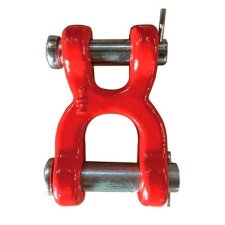
This section presents various types of lifting links used in the production of slings and lifting devices. All links are made of high-quality steel in compliance with European standards, also applicable in Ukraine. Each link undergoes mandatory load testing and comes with a quality certificate.
Design Features and Types of Links
Lifting links are classified by shape and design into the following types:
-
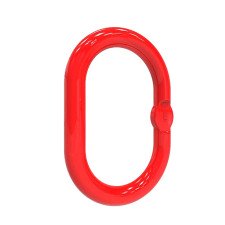
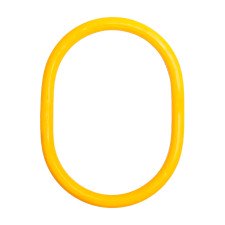
Oval Links (OB)
These universal components are used in lifting systems. They feature a closed design with smooth internal surfaces, making them ideal as end and connecting links for chain, textile, and wire rope slings. Oval links are equipped with special flat sections for easy attachment of other components, such as hooks or carabiners. Thanks to their strength and easy installation, oval links are often used in multi-leg slings to evenly distribute the load. -
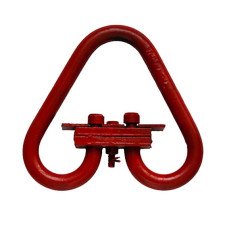
Triangular Links (RT)
Detachable connecting elements designed for multi-leg slings, such as four-leg wire rope slings. They ensure secure attachment of sling branches to the main lifting assembly. -
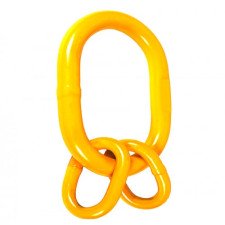
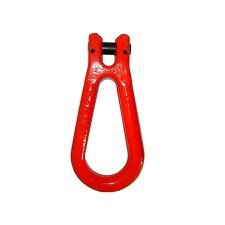
Links with Two Rings
Used for assembling three- and four-leg slings. They ensure even load distribution among the chain branches. -
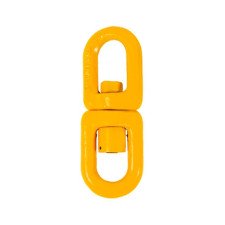
Swivel Links
These consist of two closed rings connected by a swivel joint. Swivel links allow the load to rotate around its axis, preventing twisting of ropes and chains while reducing stress on the slings. -
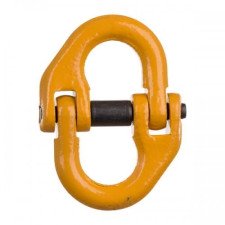
Transition Connecting Links
Designed for connecting different components of slings, such as chains, hooks, etc. Made of high-quality steel and coated with special anti-corrosion materials to withstand harsh environmental conditions. -
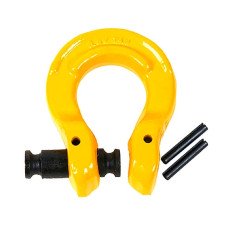
Weld-On Links
Used as attachment points in rigging operations. Widely applied in various industries due to their ability to be mounted on any metal surface. -
G80 and G100 Links
Links with G80 strength class are known for their high resistance to loads and durability. G100 links provide the same lifting capacity while being lighter, making them more convenient to use.
Key Features of Link Usage
The use of lifting links ensures the assembly of slings of any length and configuration. The main benefits include:
- Stable lifting capacity under various operating conditions.
- Reliability and safety when working with any type of load.
- Easy installation and replacement in case of defects.
- Usability in all weather and temperature conditions.
Applications of Links
Links for attaching loads to hooks or connecting sling components are used across various industries, such as construction, woodworking, and agriculture.
Buy Lifting Links
We offer a wide range of oval, triangular, weld-on links, swivels, and more with delivery across Ukraine. Our catalog includes links with G80 and G100 strength classes, meeting the highest quality standards. Prices are competitive as we work directly with manufacturers.